ORIGIN: Hindu (Puranic)
TYPE: Goddess of destruction
KNOWN PERIOD OF WORSHIP: Circa CE 400, but known from much earlier times, until present.
SYNONYMS: Many epithets, also linked with Durga
CENTER(S) OF CULT: Chiefly in Bengal
ART REFERENCES: Sculptures in stone and bronze
LITERARY SOURCES: Ramayana Epic and various Puranic texts.
INFORMATION: Kali is the most terrible and malignant aspect of the goddess Sakti (see also Durga) though the name Kali is an epithet applied to several goddesses. She is the central figure of the Sakta cult in Bengal. Her consort is generally perceived as Siva, whom she aids and abets in his more malignant aspects. She is also one of the Mahavidya personifications of the Sakti of Siva. In her earliest form she may have been the personification of the spirit of evil.
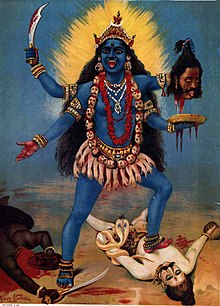
She is depicted variously with long ragged locks, fang-like teeth or even tusks, lips smeared or dripping with blood and clawlike hands with long nails. Her tongue often protrudes. She has no special vehicle but may be seen dancing on a prostrate Siva. She possesses ten (sometimes as many as eighteen) arms and may wear a necklace of skulls, a belt of severed arms, earrings of children's corpses, and snakes as bracelets. Often she is half-naked with black skin. Kali is depicted wading through gore on the battlefield and drinking the blood of her victims. Frequently she holds a severed head in one of her hands and a large sword in another. At cremation sites she sits upon the body of the deceased surrounded by attendant jackals.
There are also more benign aspects of Kali. She slaughters demons and sometimes her hands are raised in blessing. The conflict of her personality follows the widely held notion that out of destruction comes rebirth.
Kali is worshiped in Bengal during the Dipavali festival. In southern India she is worshiped as a distinct plague goddess associated with cholera.
ATTRIBUTES: Include a cup or skull.